Why: The iconostasis is a wall of icons that separates and unites the sanctuary and the nave.
The doors in the middle of the iconostasis are called the ____ Doors.
Answer: Royal / Holy
Why: The Royal (or Holy) Doors are in the center of the iconostasis.
In an icon of Mary, she points us to Jesus.
True
False
Why: True! The Mother of God holds Christ and points to him, showing us the way.
How do Byzantine Catholics receive Holy Communion?
From a golden spoon
From a cup they hold themselves
They do not receive it
Why: The priest gives the Body and Blood of Christ with a spoon, for the cleansing from sins.
The Church holds all lawfully recognized rites to be of equal right and dignity.
True
False
Why: True! Catechism 1203: all lawful rites are “of equal right and dignity.”
Read the words of the video
What does it look like inside Byzantine Churches? Do they look just like Roman Cathothic churches and why do they take communion with a spoon? Let’s find out with today’s lesson. I’m your host Shalone Cason, and let’s begin in the name of the Father and of the Son and of the Holy Spirit.
A wall of icons
The first thing you notice is a wall of icons in front of the altar. It is a wall that...
“separates and at the same time unites the sanctuary and nave.” (Christ – Our Pascha 600)
The wall is called the iconostasis. The altar side is like heaven, and the side where the people stand is like our world. The icons look at us from heaven, so it is more like a window than a wall.
The doors to the Kingdom
A great Ukrainian archbishop said...
“the doors to God’s eternal kingdom.” (Christ – Our Pascha 601)
In the middle of the wall are the Royal Doors. When they open during the Divine Liturgy, it shows that God opens heaven to us. The priest comes out through them to bring us the Gospel and Holy Communion.
Icons point to Christ
Every icon points to one person, as the Catechism explains.
“principally represents Christ.” (Catechism 1159)
On one side of the Royal Doors is the icon of Christ, blessing us. On the other is Mary, the Mother of God, holding Jesus and pointing to him. Mary always shows us the way to her Son!
Communion with a spoon
Byzantine Catholics receive Holy Communion from a golden spoon. The priest gives...
“the most pure Body and precious Blood of Christ for the cleansing from sins.” (Christ – Our Pascha 646)
Long ago, an angel touched the prophet Isaiah’s lips with a burning coal, and his sin was taken away. In the same way, Jesus comes to our lips in Holy Communion to make us clean.
Different, but equal
The Church says every lawful way of praying is...
“of equal right and dignity” (Catechism 1203)
A Roman Catholic church looks different inside, but it teaches the same faith. Both come from the apostles. Together they show us more of Jesus than either one could alone!
In a nutshell, Byzantine Churches have a wall of icons called an iconostasis, with royal or Holy doors in the middle. They take communion with a spoon, and the differences between Eastern and Western catholic churches reveal other ways we can worship Christ. Thanks for learning with us. I’ve been your host, Shalone, and until next time, stay holy, my friends.
Written and narrated by Shalone Cason, who chose the topic, selected the points, and reviewed every line. Researched and drafted with AI assistance (Claude) from the sources above. Every quotation is checked word for word against its source.
0:00
/0:00
Quiz: Inside a Byzantine Church
What is the wall of icons called?
The iconostasis
The bell tower
The font
Why: The iconostasis is a wall of icons that separates and unites the sanctuary and the nave.
The doors in the middle of the iconostasis are called the ____ Doors.
Answer: Royal / Holy
Why: The Royal (or Holy) Doors are in the center of the iconostasis.
In an icon of Mary, she points us to Jesus.
True
False
Why: True! The Mother of God holds Christ and points to him, showing us the way.
How do Byzantine Catholics receive Holy Communion?
From a golden spoon
From a cup they hold themselves
They do not receive it
Why: The priest gives the Body and Blood of Christ with a spoon, for the cleansing from sins.
The Church holds all lawfully recognized rites to be of equal right and dignity.
True
False
Why: True! Catechism 1203: all lawful rites are “of equal right and dignity.”
Read the words of the video
What does it look like inside Byzantine Churches? Do they look just like Roman Cathothic churches and why do they take communion with a spoon? Let’s find out with today’s lesson. I’m your host Shalone Cason, and let’s begin in the name of the Father and of the Son and of the Holy Spirit.
A wall of icons
The first thing you notice is a wall of icons in front of the altar. It is a wall that...
“separates and at the same time unites the sanctuary and nave.” (Christ – Our Pascha 600)
The wall is called the iconostasis. The altar side is like heaven, and the side where the people stand is like our world. The icons look at us from heaven, so it is more like a window than a wall.
The doors to the Kingdom
A great Ukrainian archbishop said...
“the doors to God’s eternal kingdom.” (Christ – Our Pascha 601)
In the middle of the wall are the Royal Doors. When they open during the Divine Liturgy, it shows that God opens heaven to us. The priest comes out through them to bring us the Gospel and Holy Communion.
Icons point to Christ
Every icon points to one person, as the Catechism explains.
“principally represents Christ.” (Catechism 1159)
On one side of the Royal Doors is the icon of Christ, blessing us. On the other is Mary, the Mother of God, holding Jesus and pointing to him. Mary always shows us the way to her Son!
Communion with a spoon
Byzantine Catholics receive Holy Communion from a golden spoon. The priest gives...
“the most pure Body and precious Blood of Christ for the cleansing from sins.” (Christ – Our Pascha 646)
Long ago, an angel touched the prophet Isaiah’s lips with a burning coal, and his sin was taken away. In the same way, Jesus comes to our lips in Holy Communion to make us clean.
Different, but equal
The Church says every lawful way of praying is...
“of equal right and dignity” (Catechism 1203)
A Roman Catholic church looks different inside, but it teaches the same faith. Both come from the apostles. Together they show us more of Jesus than either one could alone!
In a nutshell, Byzantine Churches have a wall of icons called an iconostasis, with royal or Holy doors in the middle. They take communion with a spoon, and the differences between Eastern and Western catholic churches reveal other ways we can worship Christ. Thanks for learning with us. I’ve been your host, Shalone, and until next time, stay holy, my friends.
Written and narrated by Shalone Cason, who chose the topic, selected the points, and reviewed every line. Researched and drafted with AI assistance (Claude) from the sources above. Every quotation is checked word for word against its source.
0:00
/0:00
Quiz: What Does Byzantine Mean?
Where does the word “Byzantine” come from?
A king named Peter
The city of Byzantium, named for Byzas
A kind of bread
Why: The city was “naturally called Byzantion” after Byzas, its founder.
Byzantium was renamed ____, after Emperor Constantine.
Answer: Constantinople
Why: Constantine made it his capital, and the city took his name: Constantinople.
“Byzantine” is a way of praying that many different peoples share.
True
False
Why: True! Greeks, Slavs, Arabs and others pray the Byzantine liturgy, which spread from Constantinople.
What did Byzantine Catholics keep?
Their Byzantine prayers, and unity with Rome
Only the Roman Rite
Neither one
Why: They kept their Byzantine way of praying and stayed in communion with the Church of Rome.
Byzantine Catholics and Orthodox Christians pray the same Byzantine liturgy.
True
False
Why: True! The difference is unity with the Pope. The Catechism says our communion “lacks little to attain the fullness” (CCC 838).
Read the words of the video
Byzantium, Constantinople, Istanbul...what do these 3 names have in common? Well, these are all names of one city, and the word Byzantine comes from this city. Not only that, but Byzantine Rite Catholics get their traditions from here too. Let’s explore more with this lesson. I’m your host, Shalone Cason, and let’s begin in the name of the Father and of the Son and of the Holy Spirit.
A city named for Byzas
A long time ago, a leader named Byzas founded a city, and it took his name.
“Byzas, after whom the city was naturally called Byzantion” (Catholic Encyclopedia, “Constantinople”)
Byzantion, or Byzantium, was a Greek city on a narrow strait where Europe meets Asia. It was the city of Byzas. So when we say “Byzantine,” we mean “from Byzantium.”
Constantine’s new capital
Emperor Constantine, the first Christian emperor, chose Byzantium for his new capital.
“the solemn inauguration of the new city did not occur until 11 May, 330” (Catholic Encyclopedia, “Constantinople”)
Constantine gave the city a new name: Constantinople, which means the city of Constantine! It was also called a “New Rome.” Its great church was Hagia Sophia, which means Holy Wisdom. So Byzantium became Constantinople.
A way of praying that spread
The way Constantinople prayed spread far beyond the city. The Byzantine Rite was...
“by far the most widely spread in the world.” (Catholic Encyclopedia, “The Rite of Constantinople”)
This means that this way of praying spread all over. Missionaries carried the Gospel from Constantinople to many peoples, like the Slavs in Kyiv. Greeks, Slavs, Arabs, and others all prayed this same way. So “Byzantine” means a way of praying!
Still with the Pope
A Byzantine catechism tells how the Church of Kyiv stayed close to the Church of Rome. Kyiv
“remained in communion with the Church of Rome” (Christ – Our Pascha 307)
Over the years, Rome and Constantinople drifted apart. But the Church of Kyiv kept its Byzantine prayers and stayed united with Rome. Byzantine Catholics get their history and traditions from Constantinople and Kyiv.
Close to the Orthodox
The Catechism says Catholics and the Orthodox are very close. The Orthodox community...
“lacks little to attain the fullness” (Catechism 838)
This means that it wouldn’t take much for our churches, Catholic and Orthodox, to reunite. That’s because Orthodox Christians pray the same Byzantine liturgy, with the same icons and feasts. The difference is unity with the Pope. Even though we are so close, it will be hard for everyone to agree, soWe pray that one day we’ll all be together again!
So what does Byzantine mean? It was the name of a city that became Constantinople, the capital of the Roman Empire. It also became the name of the way people from that city prayed, and even though Orthodox and eastern catholics both share the Byzantine tradition, only the Eastern Catholics are in full communion with the Pope. Thanks for learning with us, and until next time, stay holy my friend
Every pixel drawing in this video is drawn by hand by Shalone Cason.
Written and narrated by Shalone Cason, who chose the topic, selected the points, and reviewed every line. Researched and drafted with AI assistance (Claude) from the sources above. Every quotation is checked word for word against its source.
0:00
/0:00
Quiz: What Is the Byzantine Rite?
“It was in ____ that the disciples were first called Christians.”
Answer: Antioch
Why: Acts 11:26. Christians got their name in the city of Antioch.
Byzantine worship grew from the way Christians prayed in Antioch.
True
False
Why: True! The Catholic Encyclopedia says it “is derived from that of Antioch.”
What do Byzantine Catholics and Roman Catholics share?
The same church buildings
The same faith and sacraments
Nothing at all
Why: We share one faith and the same seven sacraments. We just pray in different ways (CCC 1202).
The Catholic Church is only the Roman, or Latin, Church.
True
False
Why: False! The Catholic Church is a family of Churches, Eastern and Western (Christ – Our Pascha 285).
Who are all the Catholic Churches united with?
The Pope, who takes Saint Peter’s place
The king of Constantinople
Nobody
Why: All the Catholic Churches are united with the Pope, “the successor of the apostle Peter” (Christ – Our Pascha 291).
Read the words of the video
Some Catholics pray with icons and receive communion with a spoon, but why do they do this, and who are they? Well, let’s get a quick introduction to Byzantine Rite Catholics with this lesson. I’m your host, Shalone Cason, and as always, we’ll begin in the name of the Father, and of the Son, and of the Holy Spirit.
It started in Antioch
Long ago, Jesus’s followers spread the Good News to a big city called Antioch.
“it was in Antioch that the disciples were first called Christians.” (Acts 11:26)
That’s where Christians got their name! Saint Peter and Saint Paul both lived there for a while, and the way Antioch prayed is where our story begins.
Its prayers came from Antioch
An old Catholic encyclopedia tells us where Byzantine worship comes from.
“It is derived from that of Antioch.” (Catholic Encyclopedia, “The Rite of Constantinople”)
It grew from the way Antioch prayed, then grew up in a great city called Constantinople. Its old name was Byzantium, and that’s where the word Byzantine comes from!
One faith, many ways to pray
The Catechism tells us why Catholics pray in different ways.
“Churches of the same geographical and cultural area came to celebrate the mystery of Christ through particular expressions characterized by the culture” (Catechism 1202)
Byzantine and Roman Catholics believe the same things and share the same seven sacraments. We just pray differently: Byzantine churches are full of icons, and the whole Liturgy is sung!
A big Church family
A Byzantine catechism tells us how the Catholic Church is put together.
“It is in these, and formed out of them, that the one and unique Catholic Church exists.” (Christ – Our Pascha 285)
The Catholic Church is a big family of Churches, each with its own bishops. The Latin Church is the biggest. The Ruthenian, Ukrainian and Melkite Churches are Byzantine. Together, they’re one Church!
Together with the Pope
What makes all these Churches Catholic? The same catechism tells us.
“The first among self-governing Churches is the Church of Rome, because its presider is the Pope of Rome, the successor of the apostle Peter.” (Christ – Our Pascha 291)
The Pope takes Saint Peter’s place, and all these Churches are united with him. So Byzantine and Roman Catholics can receive Communion in each other’s churches!
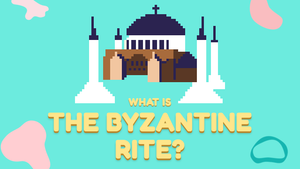
And that’s the Byzantine Rite in a nutshell. It’s a form of prayer started in Antioch, and it is one of the many ways that Catholics can pray while still being one church in communion with the Pope! Thanks for learning with me, and until next time, stay holy, my friend.
Christ – Our Pascha: Catechism of the Ukrainian Catholic Church, 285, 291
Every pixel drawing in this video is drawn by hand by Shalone Cason.
Written and narrated by Shalone Cason, who chose the topic, selected the points, and reviewed every line. Researched and drafted with AI assistance (Claude) from the sources above. Every quotation is checked word for word against its source.
0:00
/0:00
Quiz: Inside a Byzantine Church
What is the wall of icons called?
The iconostasis
The bell tower
The font
Why: The iconostasis is a wall of icons that separates and unites the sanctuary and the nave.
The doors in the middle of the iconostasis are called the ____ Doors.
Answer: Royal / Holy
Why: The Royal (or Holy) Doors are in the center of the iconostasis.
In an icon of Mary, she points us to Jesus.
True
False
Why: True! The Mother of God holds Christ and points to him, showing us the way.
How do Byzantine Catholics receive Holy Communion?
From a golden spoon
From a cup they hold themselves
They do not receive it
Why: The priest gives the Body and Blood of Christ with a spoon, for the cleansing from sins.
The Church holds all lawfully recognized rites to be of equal right and dignity.
True
False
Why: True! Catechism 1203: all lawful rites are “of equal right and dignity.”
Read the words of the video
What does it look like inside Byzantine Churches? Do they look just like Roman Cathothic churches and why do they take communion with a spoon? Let’s find out with today’s lesson. I’m your host Shalone Cason, and let’s begin in the name of the Father and of the Son and of the Holy Spirit.
A wall of icons
The first thing you notice is a wall of icons in front of the altar. It is a wall that...
“separates and at the same time unites the sanctuary and nave.” (Christ – Our Pascha 600)
The wall is called the iconostasis. The altar side is like heaven, and the side where the people stand is like our world. The icons look at us from heaven, so it is more like a window than a wall.
The doors to the Kingdom
A great Ukrainian archbishop said...
“the doors to God’s eternal kingdom.” (Christ – Our Pascha 601)
In the middle of the wall are the Royal Doors. When they open during the Divine Liturgy, it shows that God opens heaven to us. The priest comes out through them to bring us the Gospel and Holy Communion.
Icons point to Christ
Every icon points to one person, as the Catechism explains.
“principally represents Christ.” (Catechism 1159)
On one side of the Royal Doors is the icon of Christ, blessing us. On the other is Mary, the Mother of God, holding Jesus and pointing to him. Mary always shows us the way to her Son!
Communion with a spoon
Byzantine Catholics receive Holy Communion from a golden spoon. The priest gives...
“the most pure Body and precious Blood of Christ for the cleansing from sins.” (Christ – Our Pascha 646)
Long ago, an angel touched the prophet Isaiah’s lips with a burning coal, and his sin was taken away. In the same way, Jesus comes to our lips in Holy Communion to make us clean.
Different, but equal
The Church says every lawful way of praying is...
“of equal right and dignity” (Catechism 1203)
A Roman Catholic church looks different inside, but it teaches the same faith. Both come from the apostles. Together they show us more of Jesus than either one could alone!
In a nutshell, Byzantine Churches have a wall of icons called an iconostasis, with royal or Holy doors in the middle. They take communion with a spoon, and the differences between Eastern and Western catholic churches reveal other ways we can worship Christ. Thanks for learning with us. I’ve been your host, Shalone, and until next time, stay holy, my friends.
Written and narrated by Shalone Cason, who chose the topic, selected the points, and reviewed every line. Researched and drafted with AI assistance (Claude) from the sources above. Every quotation is checked word for word against its source.
0:00
/0:00
Quiz: What Does Byzantine Mean?
Where does the word “Byzantine” come from?
A king named Peter
The city of Byzantium, named for Byzas
A kind of bread
Why: The city was “naturally called Byzantion” after Byzas, its founder.
Byzantium was renamed ____, after Emperor Constantine.
Answer: Constantinople
Why: Constantine made it his capital, and the city took his name: Constantinople.
“Byzantine” is a way of praying that many different peoples share.
True
False
Why: True! Greeks, Slavs, Arabs and others pray the Byzantine liturgy, which spread from Constantinople.
What did Byzantine Catholics keep?
Their Byzantine prayers, and unity with Rome
Only the Roman Rite
Neither one
Why: They kept their Byzantine way of praying and stayed in communion with the Church of Rome.
Byzantine Catholics and Orthodox Christians pray the same Byzantine liturgy.
True
False
Why: True! The difference is unity with the Pope. The Catechism says our communion “lacks little to attain the fullness” (CCC 838).
Read the words of the video
Byzantium, Constantinople, Istanbul...what do these 3 names have in common? Well, these are all names of one city, and the word Byzantine comes from this city. Not only that, but Byzantine Rite Catholics get their traditions from here too. Let’s explore more with this lesson. I’m your host, Shalone Cason, and let’s begin in the name of the Father and of the Son and of the Holy Spirit.
A city named for Byzas
A long time ago, a leader named Byzas founded a city, and it took his name.
“Byzas, after whom the city was naturally called Byzantion” (Catholic Encyclopedia, “Constantinople”)
Byzantion, or Byzantium, was a Greek city on a narrow strait where Europe meets Asia. It was the city of Byzas. So when we say “Byzantine,” we mean “from Byzantium.”
Constantine’s new capital
Emperor Constantine, the first Christian emperor, chose Byzantium for his new capital.
“the solemn inauguration of the new city did not occur until 11 May, 330” (Catholic Encyclopedia, “Constantinople”)
Constantine gave the city a new name: Constantinople, which means the city of Constantine! It was also called a “New Rome.” Its great church was Hagia Sophia, which means Holy Wisdom. So Byzantium became Constantinople.
A way of praying that spread
The way Constantinople prayed spread far beyond the city. The Byzantine Rite was...
“by far the most widely spread in the world.” (Catholic Encyclopedia, “The Rite of Constantinople”)
This means that this way of praying spread all over. Missionaries carried the Gospel from Constantinople to many peoples, like the Slavs in Kyiv. Greeks, Slavs, Arabs, and others all prayed this same way. So “Byzantine” means a way of praying!
Still with the Pope
A Byzantine catechism tells how the Church of Kyiv stayed close to the Church of Rome. Kyiv
“remained in communion with the Church of Rome” (Christ – Our Pascha 307)
Over the years, Rome and Constantinople drifted apart. But the Church of Kyiv kept its Byzantine prayers and stayed united with Rome. Byzantine Catholics get their history and traditions from Constantinople and Kyiv.
Close to the Orthodox
The Catechism says Catholics and the Orthodox are very close. The Orthodox community...
“lacks little to attain the fullness” (Catechism 838)
This means that it wouldn’t take much for our churches, Catholic and Orthodox, to reunite. That’s because Orthodox Christians pray the same Byzantine liturgy, with the same icons and feasts. The difference is unity with the Pope. Even though we are so close, it will be hard for everyone to agree, soWe pray that one day we’ll all be together again!
So what does Byzantine mean? It was the name of a city that became Constantinople, the capital of the Roman Empire. It also became the name of the way people from that city prayed, and even though Orthodox and eastern catholics both share the Byzantine tradition, only the Eastern Catholics are in full communion with the Pope. Thanks for learning with us, and until next time, stay holy my friend
Every pixel drawing in this video is drawn by hand by Shalone Cason.
Written and narrated by Shalone Cason, who chose the topic, selected the points, and reviewed every line. Researched and drafted with AI assistance (Claude) from the sources above. Every quotation is checked word for word against its source.
0:00
/0:00
Quiz: What Is the Byzantine Rite?
“It was in ____ that the disciples were first called Christians.”
Answer: Antioch
Why: Acts 11:26. Christians got their name in the city of Antioch.
Byzantine worship grew from the way Christians prayed in Antioch.
True
False
Why: True! The Catholic Encyclopedia says it “is derived from that of Antioch.”
What do Byzantine Catholics and Roman Catholics share?
The same church buildings
The same faith and sacraments
Nothing at all
Why: We share one faith and the same seven sacraments. We just pray in different ways (CCC 1202).
The Catholic Church is only the Roman, or Latin, Church.
True
False
Why: False! The Catholic Church is a family of Churches, Eastern and Western (Christ – Our Pascha 285).
Who are all the Catholic Churches united with?
The Pope, who takes Saint Peter’s place
The king of Constantinople
Nobody
Why: All the Catholic Churches are united with the Pope, “the successor of the apostle Peter” (Christ – Our Pascha 291).
Read the words of the video
Some Catholics pray with icons and receive communion with a spoon, but why do they do this, and who are they? Well, let’s get a quick introduction to Byzantine Rite Catholics with this lesson. I’m your host, Shalone Cason, and as always, we’ll begin in the name of the Father, and of the Son, and of the Holy Spirit.
It started in Antioch
Long ago, Jesus’s followers spread the Good News to a big city called Antioch.
“it was in Antioch that the disciples were first called Christians.” (Acts 11:26)
That’s where Christians got their name! Saint Peter and Saint Paul both lived there for a while, and the way Antioch prayed is where our story begins.
Its prayers came from Antioch
An old Catholic encyclopedia tells us where Byzantine worship comes from.
“It is derived from that of Antioch.” (Catholic Encyclopedia, “The Rite of Constantinople”)
It grew from the way Antioch prayed, then grew up in a great city called Constantinople. Its old name was Byzantium, and that’s where the word Byzantine comes from!
One faith, many ways to pray
The Catechism tells us why Catholics pray in different ways.
“Churches of the same geographical and cultural area came to celebrate the mystery of Christ through particular expressions characterized by the culture” (Catechism 1202)
Byzantine and Roman Catholics believe the same things and share the same seven sacraments. We just pray differently: Byzantine churches are full of icons, and the whole Liturgy is sung!
A big Church family
A Byzantine catechism tells us how the Catholic Church is put together.
“It is in these, and formed out of them, that the one and unique Catholic Church exists.” (Christ – Our Pascha 285)
The Catholic Church is a big family of Churches, each with its own bishops. The Latin Church is the biggest. The Ruthenian, Ukrainian and Melkite Churches are Byzantine. Together, they’re one Church!
Together with the Pope
What makes all these Churches Catholic? The same catechism tells us.
“The first among self-governing Churches is the Church of Rome, because its presider is the Pope of Rome, the successor of the apostle Peter.” (Christ – Our Pascha 291)
The Pope takes Saint Peter’s place, and all these Churches are united with him. So Byzantine and Roman Catholics can receive Communion in each other’s churches!
And that’s the Byzantine Rite in a nutshell. It’s a form of prayer started in Antioch, and it is one of the many ways that Catholics can pray while still being one church in communion with the Pope! Thanks for learning with me, and until next time, stay holy, my friend.
Christ – Our Pascha: Catechism of the Ukrainian Catholic Church, 285, 291
Every pixel drawing in this video is drawn by hand by Shalone Cason.
Written and narrated by Shalone Cason, who chose the topic, selected the points, and reviewed every line. Researched and drafted with AI assistance (Claude) from the sources above. Every quotation is checked word for word against its source.
0:00
/2:36
🎵
Music, vocals, and lyrics: Shalone Cason
Lyrics
CHORUS The priest says this is my body, this is my blood, When it's time for communion. And Jesus said, "This is my body. This is my blood," And that's holy communion.
The last supper was the first Holy Communion. At Liturgy, we celebrate Holy Communion. Jesus said Remember Him in Holy Communion. Jesus takes bread and wine and makes Holy Communion.
CHORUS
Every child of God should take their first Holy Communion. Go to Liturgy and celebrate Holy Communion. If you want to honor Christ, partake in Holy Communion. If you want eternal life, you will receive Holy Communion.
Our top video on YouTube was What is A Conclave with 8,300 views.
We had views all over the world! The US was top with4,600visits (+100) and India was second with358visits. We even had visitors from Pakistan and Iran.
We have 16 free members (+7), and 0 paid members.
We have not collected any donations at this time. However, we need your assistance to break even on hosting and computer equipment. It is our goal to make full 3D animated videos for each new song and lesson we create in 2026. The computing power required for these videos is very expensive. We will not be using AI to create these videos; therefore, it is very time-consuming as well.
If you appreciate human-made and heartfelt animated songs and lessons for Catholic kids, please consider becoming a paid member or giving a one-time donation.